




Follow the GTA$
GTA VI.AI v1.88.1
ERA 5 · 2025/26 Projected

GTA VI Economy

The most structurally sophisticated virtual economy ever designed. Two territories, one currency — a dual-territory currency union analogous to the Eurozone. Everything we know and predict, sourced from the franchise arc.

17
complexity score
franchise maximum
2
economic territories
Vice City · Leonida
13
economic predictions
model-derived
443M
trailer views · combined
live · YouTube API
// Projected Circular Economy
dual-territory · all nodes projected
2025/26 — Dual Territory (Projected) Projected
SOVEREIGN
Rockstar / Take-Two
Deeper ownership economy · Possible dual-territory price levels · Mobile-linked persistence · Shark Cards persist
Regional price floors (projected) Shark Card cross-region rates (projected) Mission payout floors per territory (projected) Weekly events — regional bonus rotations (projected) Mobile-linked persistence (projected)
Vice City (Urban)
High prices · High wages · Dense economy
Businesses
clubs · heists
Players
Lucia · Jason
Leonida (Rural)
Lower prices · Lower wages · Sparse economy
Businesses
smuggling · farms
Players
Lucia · Jason
player movement
Shark Cards
cross-region real-money injection · Deepens as structural revenue imperative
Economy Type
Dual-territory currency union
Real-World Analogue
Internal currency union — Eurozone
Key Innovation ★★★★
Regional purchasing parity — two structural economies, one currency
One monetary authority (Rockstar as ECB), two structurally different regional economies. If price divergence is real, GTA-RPP would differ by region — a new research axis unique to this site.
Inflation Channels
Regional price divergence — Vice City vs Leonida purchasing power gap (projected)
Shark Card ratio degradation — structural, inherits from GTA Online
Payout nerfs — expected to continue as live-service mechanic
GTA VI Lineage

GTA VI is the culmination of the franchise arc. The dual-territory model is the most structurally sophisticated virtual economy ever designed — applying the Eurozone currency union model to a video game for the first time.


Source: GTAVI.AI Economic Model — predicted pre-launch · GTA Online precedent · trailer analysis
GTAVI.AI
// Economic Complexity — Franchise Context
All 10 economies →
Economic Complexity Projected
5 dimensions · franchise baseline comparison
17
/ 17 max
GTA VI
Franchise avg
GTAVI.AI
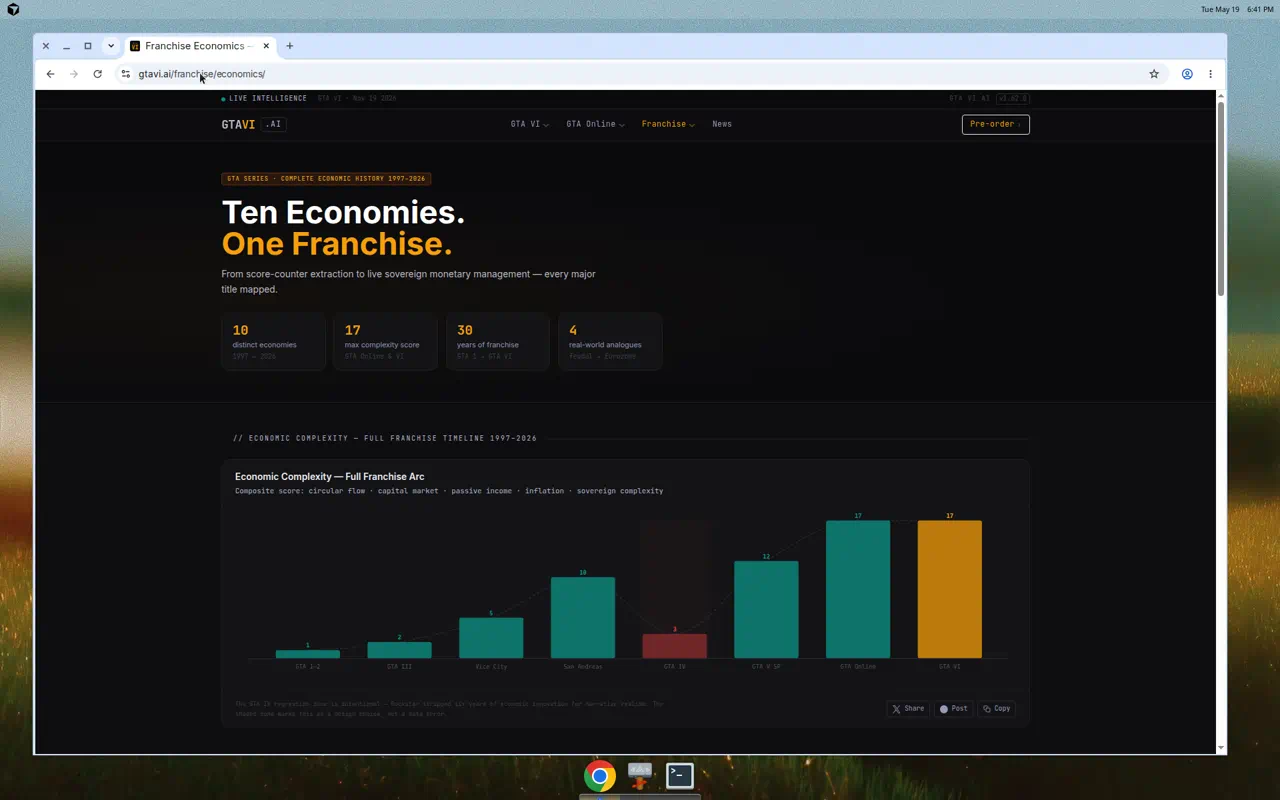
Franchise Arc — Complexity Trajectory
GTA 1–2
1
GTA III
2
Vice City
5
San Andreas
10
GTA IV
3
GTA V SP
12
GTA Online
17
GTA VI
17
The GTA IV regression zone is intentional — Rockstar stripped six years of economic innovation for narrative realism. The shaded zone marks this as a design choice, not a data error.
Analysis // The Eurozone Analogy
GTA VI Model
Monetary authority
Rockstar / Take-Two (as ECB)
Currency
GTA$ — single non-convertible currency
Region 1 (core)
Vice City — urban, dense, high-wage
Region 2 (periphery)
Leonida — rural, sparse, low-wage
Real-money injection
Shark Cards — cross-region float
Inflation mechanism
Nerf-driven + SC ratio + regional divergence
Eurozone Parallel
Monetary authority
European Central Bank
Currency
Euro — single shared currency
Core
Germany / France — high productivity, high wages
Periphery
Greece / Portugal — lower wages, lower costs
External capital
Bond markets, Target2 balances
Inflation mechanism
ECB rate policy + structural divergence

GTA VI would be the first virtual economy structurally analogous to the Eurozone — one monetary authority, two structurally different regional economies, one currency. If price divergence is real, GTA-RPP (Regional Purchasing Parity) would differ by territory — a new research axis unique to this site.

New Metric // GTA-RPP — Regional Purchasing Parity
Day-1 ready · awaiting launch data
Vice City RPP
Populates at launch
Leonida RPP
Populates at launch
RPP Ratio
VC ÷ Leonida
Formula: GTA-RPP = regional basket cost ÷ regional top hourly yield. The GTA-PPI (currently tracking GTA Online) is the single-market predecessor. GTA-RPP extends this to measure cross-territory purchasing power divergence — if Vice City wages are higher but prices are higher by a larger factor, Leonida players have higher real purchasing power. Computed nightly from confirmed launch-day data. Status: stub.
// Economic Structure Predictions
13 model-derived
Reported
80%
Region Locks on Passive Income Businesses
Trailer evidence confirms clubs and heists in Vice City; farms and smuggling operations in Leonida. The dual-territory diagram explicitly labels these. Region-specific business types would produce natural wage and passive income divergence.
Low: Cross-region businesses accessible but with efficiency penalties · High: Hard region locks — certain business types only viable in their native territory
Reported
88%
Weekly Bonus Events from Day 1 — Like GTA Online
Weekly bonus events are the primary live-service engagement loop in GTA Online, operating continuously since 2017. Take-Two earnings reports consistently cite live events as a key monetisation driver. The weekly event cadence is a structural feature of the MMT sovereign model.
Low: Bi-weekly events (reduced cadence at launch) · High: Weekly from Day 1 (continuation of GTA Online model)
Predicted
75%
GTA Online Layer Launches at or Near Day 1
Take-Two's revenue model cannot sustain a 6-month GTA Online delay (as occurred with GTA V in 2013). Shark Card revenue is the primary live-service income stream. Each month of delay costs Take-Two significant recurring revenue at the highest-demand period in franchise history.
Low: Day 1 simultaneous launch · High: 30-day delay maximum
Predicted
85%
No Loans at Maze Bank — Savings Only
Franchise-wide pattern: savings never compound in any GTA title. Maze Bank in GTA Online is explicitly decorative (no credit). No title has ever introduced a loan or credit mechanic — introducing one would fundamentally alter the Shark Card revenue model by reducing SC purchase urgency.
Low: No savings mechanic at all · High: Savings with nominal interest, still no credit
Predicted
72%
Lucia and Jason Don't Share Finances or Businesses
GTA V established per-character financial independence (Michael, Trevor, Franklin each hold separate balances). Two protagonists in GTA VI naturally extends this — particularly relevant for a dual-territory model where each character may operate primarily in one region.
Low: Shared wallet pool with per-character cosmetic preferences · High: Fully independent financial states, separate business portfolios per character
Reported
68%
Run GTA VI Businesses 24/7 via Mobile App
Take-Two's live-service strategy and the dual-territory diagram explicitly lists mobile-linked persistence. Rockstar's iFruit app precedent (GTA Online) and the broader trend toward companion apps in AAA live-service games makes this a logical evolution.
Low: Basic mobile monitoring (passive income checks) · High: Active mobile management affecting in-game business state
Predicted
78%
Rockstar Expected to Nerf Payouts Within 6 Months
GTA Online has delivered a major payout nerf within 6–18 months of every high-yield activity launch since 2015. Structural incentive: high yields suppress Shark Card sales. The question is not if GTA VI nerfs occur, but when.
Low: 3 months (if yield is high enough to threaten Shark Card revenue immediately) · High: 18 months (if Rockstar delays for goodwill at launch window)
Predicted
55%
GTA VI Megalodon Shark Card launch price
GTA Online's Megalodon Shark Card has been $99.99 since 2013. CPI adjustment to 2026 (~35% inflation) implies a real-terms equivalent of ~$135, suggesting a nominal increase is economically justified. Take-Two has historically kept nominal prices flat while engineering real-terms inflation via payout nerfs. A price increase at the launch of a new title would be the cleanest reset point.
Low: $99.99 (nominal flat continuation) · High: $119.99 (CPI reset)
Predicted
40%
Top Hourly Yield at GTA VI Online Launch
GTA Online launched at ~$250K/hr in 2013 and reached $2M/hr (Cayo Perico, 2020) before nerfs. The 8× yield growth over 7 years reflects both inflation and content scaling. GTA VI Online inherits the MMT sovereign model at a structurally higher yield floor. Historical nerf cadence suggests yields above $5M/hr are politically unsustainable for Rockstar's Shark Card model.
Low: $2M/hr (continuation of current GTA Online S-tier floor) · High: $8M/hr (new heist format with full MMT rebalancing)
Predicted
65%
Regional Price Gap — Vice City vs Leonida
Dual-territory Eurozone analogy — two structurally different regions sharing one currency (GTA$) historically produce purchasing power divergence. Urban density correlates with higher prices across GTA franchise history.
Low: 5–10% price premium in VC · High: 25–40% price premium in VC
Predicted
60%
Shark Cards With Regional Tiers or Territory Gates
Take-Two's recurring revenue dependency makes Shark Cards non-negotiable. Regional denominations or tiered access are the natural extension of the dual-territory model — mirroring real-world mobile game regional pricing strategies.
Low: Single global SC rate with regional content gates · High: Fully tiered regional SC denominations
Predicted
35%
GTA VI Endgame Cost via Shark Cards — 12 Months
GTA Online's endgame cost via Shark Cards grew from ~$18.75 (2013) to ~$437.50 (2026) — a 23× increase over 13 years. GTA VI Online starts with a reset baseline but inherits the same structural incentive to expand the aspirational item stack. The $600–$900 range assumes a 30–100% premium over GTA Online's current endgame.
Low: $437.50 (flat continuation of GTA Online ceiling) · High: $1,200 (new high-tier aspirational vehicles + regional DLC stack)
Predicted
70%
A Regional Purchasing Parity Index for GTA VI
If regional price differentials exist, a single GTA-PPI index will understate inflation for one region. The GTA-RPP — basket cost ÷ top hourly yield, computed per territory — is the essential post-launch metric for this site.
Low: GTA-RPP diverges <10% between regions · High: GTA-RPP diverges >30% — significant real wage gap between territories
// Economic Lineage — The Arc Ends Here

GTA VI projects the GTA Online MMT sovereign across two structurally different regional economies — Vice City (urban, dense, high-wage) and Leonida (rural, sparse, low-wage) — unified by one currency. The Eurozone analogy predicts regional purchasing parity divergence, a research axis unique to this site.

GTA Online → GTA VI

GTA VI is the culmination of the franchise arc. The dual-territory model is the most structurally sophisticated virtual economy ever designed — applying the Eurozone currency union model to a video game for the first time.